

The Science of Fun in Microlearning: How MaxLearn Turns Engagement into Performance
his blog explains how learning science and game psychology synergise to help trainers design microlearning that sustains attention, motivation, and performance.
In today’s digital learning landscape, ‘engagement’ is the key to delivering training that sticks. Else, it’s simply ignored. Content alone isn’t motivating. For real motivation, a learner needs emotion, challenge, curiosity, and purpose. That’s why understanding what Nicole Lazzaro says about the 4 Fun Types becomes important for trainers. When you want to create microlearning lessons that can cut through distractions to compete for attention.
MaxLearn operationalizes these 4 Fun Types with its AI-driven, powerful algorithm-enabled microlearning platform that’s Fast, Fun, and Effective.
Gamification is powerful, and MaxLearn embeds the psychology of fun into its AI-powered platform that can perform multiple tasks with ease, namely, authoring, adaptive delivery, team challenges, spaced reinforcement, and learner analytics.
The platform goes beyond adding fun, and engineers proven ‘fun-related’ frameworks that demystify the science of play and learning.
It switches seamlessly between 4 planes- (1) the curiosity-driven pull of Easy Fun, (2) the mastery challenge of Hard Fun, (3) the team-driven energy of People Fun, and (4) the deeper meaning and purpose behind Serious Fun.
These 4 fun types are ‘emotional triggers’. The platform turns each of them into structured, measurable, repeatable learning experiences that drive memory, motivation, and performance.
After exploring Lazzaro’s 4 Fun Types, we will explore how MaxLearn transforms them into real-world, high-impact microlearning outcomes. Here, psychology turns into a learning system.
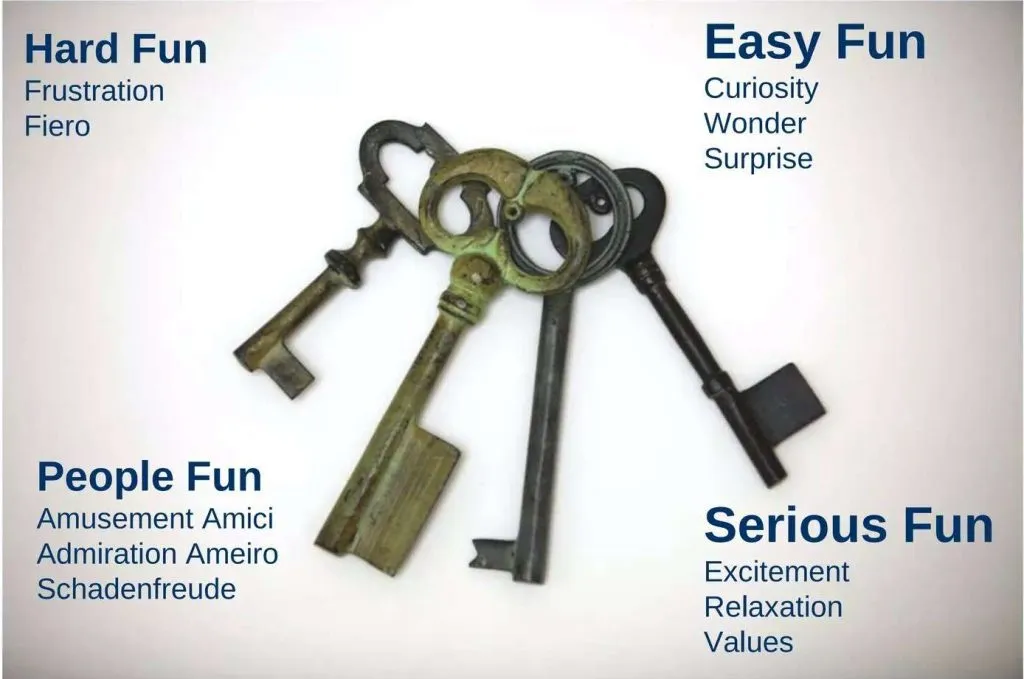
The game design process begins when your microlearning map requires a gamification asset!
And that’s when Nicole Lazzaro’s 4 fun types can come in handy. They describe the emotions and the kind of fun players experience in a game.
An interactive game design should be able to create compelling emotions that lead to intense player engagement. To do that, you first need to have a good understanding of the emotions that’ll get your learners hooked to the game!
Lazzaro’s 4 fun types make it easy for you to make the game experience engaging and fun, and let the learner experience a full range of emotions… from the agony of defeat to the thrill of victory, and all the emotions in between.
Gamification Assets and Fun – the Symbiotic Relationship
Gamification makes use of game-design elements in non-game contexts with the help of technology. The goal is to enhance learners’ motivation to play the game and respond to it. The fun element makes learning as natural as play.
This results in superior learning, higher absorption (memory retention), and quicker and better recall when needed at work. With that, you get superior learning outcomes!
These 4 fun types can be incorporated in microlearning game design to supplement, reinforce, augment, or remediate the training efforts.
Supplement: The training acts as a support, implementing different, novel, and fun ways to engage the learner.
Reinforce: The training is used to strengthen previous learning and to ensure critical elements of the training are not forgotten.
Augment: This type of training builds and adds to previous learning and helps the learner gain mastery over the topic.
Remediate: Here, the training improves on-the-job performance and encourages more appropriate/ productive behaviors, attitudes, and habits.
With this background, let’s now discuss Nicole Lazzaro’s 4 Keys to Fun, and how they can engage a player emotionally.
Lazzaro’s 4 Keys to Fun

Lazzaro’s 4 fun types can be briefly described as Easy fun, Hard fun, People fun, and Serious fun. These 4 Fun types correspond to the four basic reasons why a player plays a game – novelty, challenge, friendship, and meaning.
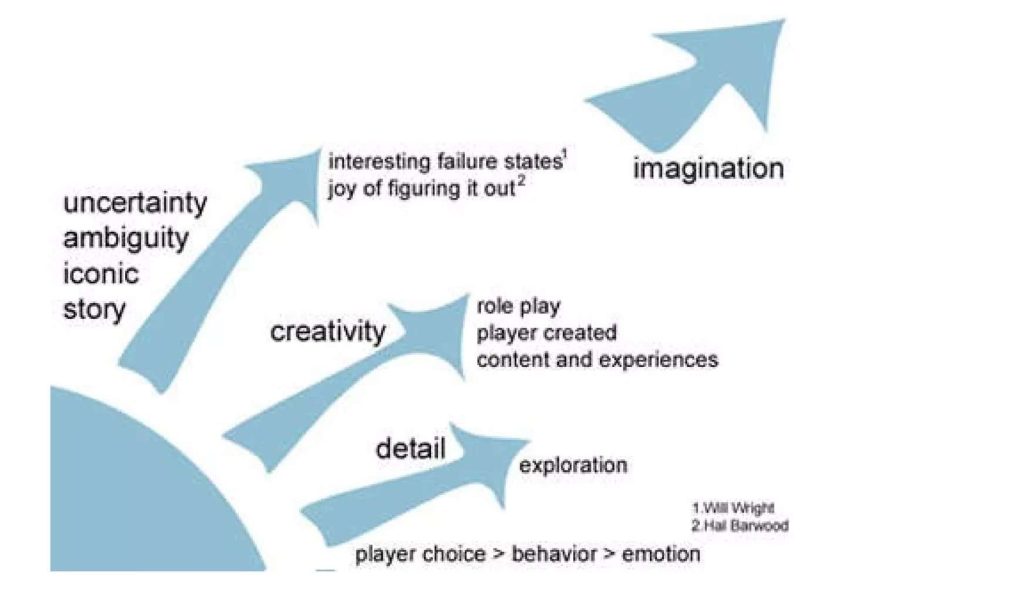
- Easy Fun →Easy fun corresponds to novelty. The player has fun exploring new worlds, new stories, etc. It is a vehicle for imagination, and is like the bubble wrap of game design.
For microlearning gamification, Easy Fun provides the hook that draws the learner into an explorative, creative fantasy, or a roleplay mode. Microlearning lessons become very absorbing with Easy Fun with the elements of curiosity, wonder, and surprise.
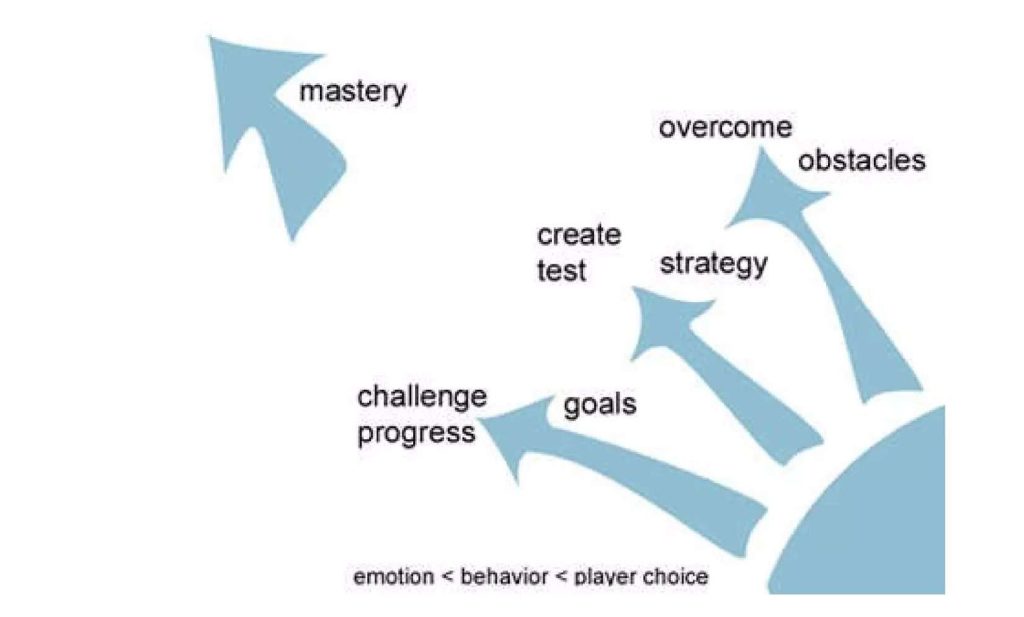
- Hard Fun →Hard Fun corresponds to challenge and mastery – ‘The Brass Ring’. Hard Fun mechanics give the learner an opportunity to master the required knowledge and skills with the help of goals, obstacles, and strategies. Hard Fun creates the emotions of frustration, boredom, relief, and eventually, Fiero (the feeling of an epic win) in the player.
Game players don’t mind the feeling of frustration, because it eventually leads to the thrill of winning! This works well for gamification in microlearning. The element of failure encourages the learner/ player to try the experience again.
Hard Fun ends with an epic win where the player overcomes obstacles while pursuing a goal. Achievements can be in the form of points and badges earned after meeting a challenge successfully. This creates effective learning and long-term memory.
- People Fun People fun corresponds to friendship, relationships, and social bonding. It includes the fun and amusement the player experiences through accomplishment, and cooperation and competition with friends.
Many games increase engagement through interaction with friends. In the People Fun construct, the community becomes more important than the game itself. Also, fun gets amplified when learning happens in the company of friends. People are more addictive eventually!

- Serious Fun →Serious Fun corresponds to meaning and provides value. It results in excitement that comes with learning and changing how people think, feel, and behave.
Serious Fun goes beyond mere points and badges. It enhances feelings of aspiration, desire, excitement, focus, and the feeling of having created something of value. Game developers must be able to understand, amplify and extend these feelings.
With Serious Fun, the learner experiences real meaning and a sense of growth. Serious fun is immensely satisfying because it engages the player on a deep cerebral level. It results in a profound feeling of Fiero that comes with a heightened sense of victory.

Serious Fun mechanics provide an end of level win experience that rewards players over time. This happens by unlocking new content or inching up a leader board. A Serious Fun interaction reinforces what’s learned with games based on repetition, rhythm, collection, and completion.
As a learning manager, knowing how these 4 Fun types work will help you create microlearning gamification assets with better understanding and clarity.
Implications, Uses, and Benefits: How MaxLearn Applies the 4 Fun Types
When learning feels like play, performance becomes unstoppable.
MaxLearn makes that happen.
Nicole Lazzaro tells us why games engage people. MaxLearn’s algorithms incorporate the same emotional triggers into microlearning. This drives powerful/sustained learning behaviors, and not just temporary or disengaged participation.
Fun Types mapped to MaxLearn’s capabilities:
| Fun Type | Emotion Triggered | How MaxLearn Activates It |
|---|---|---|
|
Easy Fun |
Curiosity, surprise |
AI-authored flashcards, scenario-based questions, adaptive paths |
|
Hard Fun |
Challenge, mastery |
Difficulty-based content, retrieval practice, badges, progression |
|
People Fun |
Belonging, competition |
Team challenges, leaderboards, nudges, participation rewards |
|
Serious Fun |
Purpose, meaning |
Goal assignments, certifications, spaced reinforcement, role-based learning |
WHY THIS MATTERS FOR TRAINERS & L&D TEAMS
- MaxLearn makes game design and application of game psychology easy for you. It embeds the mechanics so that as a trainer you are free to focus on content and learner intent.
- You get to design emotionally intelligent microlearning with microlearning maps, and create gamification based lessons with ease.
- MaxLearn’s built-in analytics helps you identify the different fun types driving engagement. This allows trainers to adjust content, difficulty, or delivery style intelligently.
- MaxLearn fuses gamification with learning science through spaced repetition, adaptive questioning, RbF reinforcement (‘Right before Forgetting’ algorithm), real-time feedback, and collaborative motivation.
The Win: Engagement design without guesswork.
With MaxLearn, you can supplement, reinforce, augment, and remediate learning with a clear understanding of the 4 Fun Types. MaxLearn’s AI-based algorithms help automate the content delivery and exposure for each learner.
Clearly, as Lazzaro suggested, people learn better when learning feels emotionally rewarding. MaxLearn builds upon this principle and makes gamification practical, scalable, measurable, repeatable, and AI-enabled (with its AI-enabled Authoring tool).
The 4 Fun Types help you build a motivated force.
MaxLearn gives you a microlearning engine that’s:
Fast: AI-enabled content creation, auto-assignments, rapid updates (flashcards)
Fun: Gamified engagement plus cognitive-emotional triggers
Effective: Adaptive learning, spaced repetition, and powerful analytics for tangible training ROI
With MaxLearn, gamification turns into a learning strategy that delivers high performance, deep-seated memory, team collaboration, and positive business outcomes. After all, engagement cannot be gambled with. It must be a designed, measurable capability.
MaxLearn for Maximum Engagement.
MaxLearn for Maximum Learning ROI.


