Argyris & Schon’s ‘Double-loop Learning’ for a Thinking Workforce

double-loop learning

From Training to Thinking: How Double-Loop Learning Powers MaxLearn’s Intelligent Microlearning

Why Training Fails When Risk Begins

Organisations that rely on one-time training keep retraining people, and keep absorbing the same operational risk. Training cost repeats. Errors repeat. Capability does not compound.

Organisations that rely on execution alone keep fixing errors instead of eliminating them.

Double-loop learning is what turns training from a ‘cost centre’ into a ‘risk-reduction’ strategic asset. It keeps behavior aligned and capability relevant as work evolves.

At a Glance

  • Fixing errors without questioning the assumptions behind processes is a fatal flaw.
  • Double-Loop Learning helps improve both judgement and execution. 
  • It helps your workforce adapt to changes viz. work ways, technology, regulations, and risks.
  • To make Double-Loop Learning possible, a good microlearning LMS uses concepts like apaptive learning, feedback loops analytics, and reinforcement.
  • Maxlearn uses these concepts to go beyond content delivery. This enables ongoing capability development.
  • The result: lesser risk, robust compliance, and most importantly, a thinking workforce.

Making Learners Think, Not Just Learn 

Making learners active participants in their own learning is every training professional’s dream! You don’t want a workforce that’s a passive recipient of knowledge. Instead, you want an engaged workforce that is thinking and questioning all the time.

Let’s explore the meaning of Single-Loop and Double-Loop Learning, and how they differ.

What Double-Loop Learning Actually Changes

As work conditions change constantly, capability must adapt continuously. One-time training creates delays!

Double-Loop Learning means continuously questioning actions, assumptions, decisions, and goals… not just correcting errors, but improving judgement.

  • Actions improve continuously: Tasks are not repeated blindly. People adjust after feedback.
  • Assumptions get questioned: rules, goals, and methods are reviewed and improved.
  • Decisions get smarter: people stop executing blindly and start exercising judgement.
  • Learning continues after training: reinforcement during real work.
  • Lapses and flaws reduce over time: errors are caught earlier to prevent bigger losses.

A good microlearning LMS needs to continuously question, evaluate, and improve the learning experience for each learner. The aim is to make every learner become a self-adjusting thinker. When this happens, improvisations happen automatically, costly mistakes are avoided, and decay of knowledge/skills is arrested.

The result: lower operational problems, stronger compliance, and durable core capability at scale.

Argyris and Schön’s Double-Loop Learning turns a microlearning platform like MaxLearn into an adaptive performance system. A platform that delivers knowledge agility and measurable operational capability. Theory is converted into powerful AI-driven adaptive algorithms that keep pace with each learner’s learning preferences, styles, and goals.

To make better sense of Double-Loop Learning, let’s first understand Single-Loop Learning.

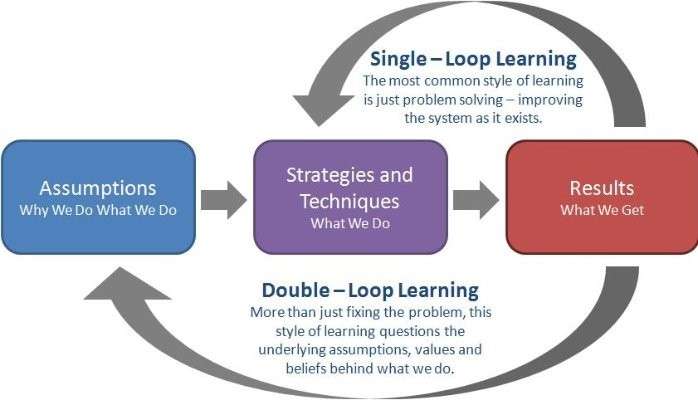
Single-loop Learning: Doing things right

Single-loop learning is a type of organizational learning about finding a solution to a problem and applying it over-and-over again. It focuses on solving problems within a rigid boundary in the existing system. When we encounter a problem, we ask ‘what’ the problem is, and then try to solve it. The issues may continue to persist, but the focus remains on ‘detection and correction of error’, even if the issue keeps returning.

The biggest limitation of this approach is that it does not question why the problem exists. It optimises actions but not decisions. It improves efficiency, but not effectiveness.

double-loop learning

Double-loop Learning: 

Double-loop learning goes deeper. It questions goals, assumptions, and rules themselves. It asks whether we are solving the right problem… not just solving the problem right.

double-loop learning

Source

Instead of fixing symptoms, it re-examines causes. Instead of optimising processes, it rethinks decisions.

This is how organisations avoid repeating mistakes at scale.

Double-loop learning allows you to modify or even reject learning goals in the light of experience. You discard dysfunctional approaches and adopt ones that actually work.

It encourages learners to think more deeply about their assumptions, beliefs, and decisions… and to adapt continuously.

Single-loop Learning vs. Double-loop Learning

Single-loop Learning Double-loop Learning
Follows current ways of doing things within the existing systemFinds short-term solutionsEncourages passive acceptance of informationFocuses on following the rules without questionLess employee involvement Questions current ways of doing thingsFinds long-term solutionsCalls for changing the rules and even learning goals when requiredEncourages questioning, criticism, feedbackMore employee involvement

double-loop learning

Source

Why Double-Loop Learning Matters in Modern Workplaces 

Double-loop learning calls for a creative, reflective approach to problem-solving. It treats problems as signals, not interruptions.

It helps learners:

  • Challenge assumptions
  • Make better decisions
  • Adapt faster to change
  • Abandon unproductive approaches early
  • Innovate safely and continuously

This is how organisations build capability using systems like MaxLearn’s microlearning platform.

How MaxLearn Operationalises Double-Loop Learning

Most LMS platforms operate in single-loop mode. They detect gaps and push more content.

MaxLearn is different. It is designed as a thinking system, not a content repository.

1. Reflection and Feedback Built In

MaxLearn’s active learning feedback captures real-time learner responses and adapts content accordingly… allowing both learners and trainers to revisit what is taught and why. The result: quick course correction.

2. Challenging Assumptions Through Adaptive AI

Adaptive algorithms adjust difficulty, progression, and challenge intensity so learners cannot coast on memorisation. They must think. The result: better judgement to handle change.

3. Reframing Goals Using Analytics

Trainers can question whether learning goals themselves are correct, not just whether learners completed them. The result: learning goals get aligned with the business.

4. Creating a Culture of Inquiry with Gamification

Gamification turns learners into contributors… not just consumers of learning.

5. Rebuilding Learning from the Ground Up

AI-powered authoring breaks content into validated learning goals aligned with role- and risk-profiles.

6. Sustaining Change Through Spaced Reinforcement

Learning is reinforced over time, transforming training into a continuous coaching system.

From Thinking Theory to Thinking Workforce

Argyris and Schön’s Double-Loop Learning is meant to shape organisations that can think, adapt, and evolve.

MaxLearn LMS turns that theory into daily practice by being fast, fun, and effective.

For trainers, this means designing learning that grows with the learner. 

For organisations, it means building capability that compounds. 

For leaders, it means reduced risk, sustained training ROI, and higher performance.

‘Double-Loop Learning occurs when errors are corrected by modifying an organisation’s underlying norms, policies, and objectives.’ [Argyris & Schön]

To know more about “How to use Nonaka & Takeuchi’s Model to Create a High-impact Learning Organization!” Click here!

Visited 1,908 times, 13 visit(s) today