

To create efficient and effective microlearning lessons, a good understanding of learning theories helps. It better enables you to create targeted, job-related lessons that help build sustainable Knowledge, Skills and Abilities (KSAs). The key lies in taking care of the ‘forgetfulness factor’ that organisations struggle with. Today, technology-intensive cutting-edge microlearning platforms help learning stick. With microlearning, you can create content that’s impactful and engaging.
At a Glance
- Gardner’s Multiple Intelligences Theory tell us how people learn differently.
- Intelligence goes beyond IQ or academic performance.
- Workplace learners have different strengths, preferences, and capabilities to learn.
- Effective microlearning provides multiple engaging learning experiences.
- Personalized learning improves engagement, retention, and real-life application.
- Adaptive microlearning platforms operationalize such learning principles and theories at scale.
- The outcome- positive workplace impact due to stronger learning, better workplace performance.
Learning Theories: The Enablers
A sound understanding of learning theories makes implementation of microlearning easier. In a lesson, you often use different aspects of how the brain learns like visual, auditory, and kinesthetic learning.
An understanding of learning theories gives you a good insight into how to make a 5-7 minute microlearning snippet more engaging and effective. Plus, you get an edge while managing microlearning strategies, content, and design.
Let’s explore Howard Gardner’s theory of Multiple Intelligences and how it is relevant to microlearning.
Using Gardner’s Multiple Intelligences theory, microlearning lessons experiences can be tailored to each learner’s cognitive strengths.
Howard Gardner’s Theory of ‘Multiple Intelligence’
Gardner’s theory is based upon the psychological concept of ‘human cognition’. It tells us about the ‘nine intelligences’.
This indicates that intelligence is more than just a single capability.
Why Multiple Intelligences Matter in Today’s Workplace
Organizations need consistent performance from their workforce, but the way each employee learns is different.
While everyone requires training, the way information is processed differs.
Changes are a reality in today’s fast-paced world, and it is all the more important to personalize learning.
Gardner’s framework helps us understand these differences. Plus, designing personalised learning experiences also becomes possible.
Human intelligences comprise the following different cognitive elements for different people.
| Gardner’s 9 Intelligences: A Snapshot | ||
|---|---|---|
| 1 | Verbal-linguistic intelligence | |
| 2 | Logical-mathematical intelligence | |
| 3 | Spatial-visual intelligence | |
| 4 | Bodily-kinesthetic intelligence | |
| 5 | Musical intelligences | |
| 6 | Interpersonal intelligence | |
| 7 | Intrapersonal | |
| 8 | Naturalist intelligence | |
| 9 | Existential intelligence | |
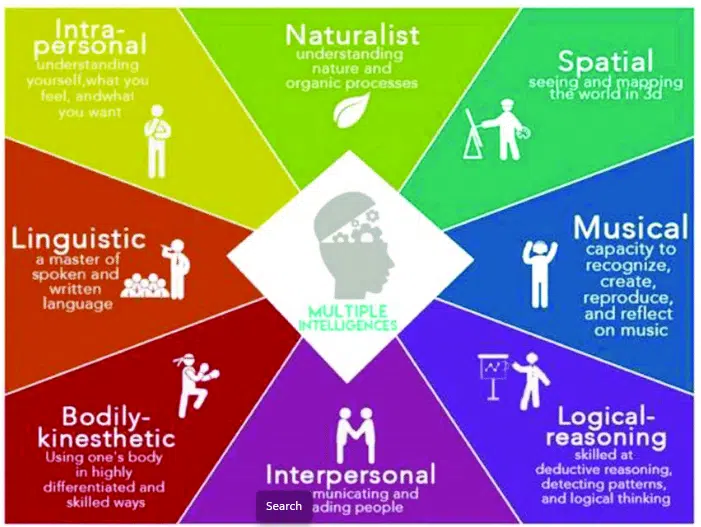
How is Gardner’s Multiple Intelligences Relevant to Microlearning?
Gardner emphasizes that teaching should involve presenting learning content in multiple ways. This is especially relevant for microlearning, designed to cater to a diverse workforce across various industries.
| Purpose | How Gardner Applies | Example |
|---|---|---|
| Supplement | Concepts introduced via multiple pathways | Short videos, infographics, scenarios |
| Reinforce | Knowledge refreshed using reinforcement methods | Flashcards, quizzes, nudges |
| Augment | Capability expanded in additional and different ways | Simulations, branching exercises |
| Remediate | Learning gaps addressed with personalised interventions | Adaptive learning paths |
Gardner's Theory Across Workplace Learning
- Healthcare: Patient scenarios, simulations, visual demonstrations, reflection.
- Financial Services: Compliance scenarios, decision-making, analytical exercises.
- Hospitality: Role-plays, guest interactions, cultural awareness activities.
- Manufacturing: Visual workflows, guided practice, troubleshooting exercises.
- Aviation: Safety drills, simulations, procedural reinforcement, decision scenarios.
Gardner's Theory Within the Broader Science of Learning
Gardner’s principles combine well with the following learning theories:
- Bloom’s Taxonomy: cognitive progression
- Cognitive Load Theory: managing mental effort
- Retrieval Practice: strengthening memory
- Spaced Repetition: long-term retention
- Adaptive Learning: personalisation
- Goal-Driven Learning: workplace performance
All the above learning theories are integrated well to create a truly robust AI-Powered microlearning LMS like MaxLearn.
How is Gardner’s Multiple Intelligences Relevant to Microlearning?
Presenting Content in Multiple Ways
Gardner speaks about offering learning content in multiple ways so that it can cater to a diverse workforce across industries.
Adapting to Diverse Intelligences
Employees use different intelligences based on their unique learning styles. The learning content also needs to reflect this for each learner. This alone can make your content interesting, relevant and custom-made to each one’s role- and risk-specific learning goals/gaps.
Balancing Individual Preferences and Business Needs
Balancing individual learning preferences becomes easier with Gardner’s 9 Intelligences.
Moving Beyond One-Size-Fits-All
By applying Gardner’s theory, you move away from the “one-size-fits-all” training risk. With microlearning content tailored to meet the unique needs and preferences of each learner, you get strong and sustainable training ROI.
Crafting Inclusive Microlearning Strategies
For effective training, microlearning strategies should be based on the different intelligences of your workforce. This makes your learning content more inclusive. This tailored strategy embedded in a microlearning platform helps each learner.

Personalized Learning Paths: Leveraging Gardner’s 9 Intelligences for Effective Microlearning
Gardner says that anything you are well aware of can be described and conveyed in many ways.
Training managers need to be equipped to deliver content in different ways, almost like a chef who can cater to people with different tastes.
Example of differences within a sales team:
- John grasps concepts best through logical-mathematical intelligence
- Peter likes visual-spatial intelligence based content
Hence, if you know your team’s intelligence preferences, you can tailor your microlearning lessons accordingly.
Likewise, even the same lesson can be presented in different styles. This allows each learner to choose the one that best fits their learning preference.
This way, your message reaches your target audiences each time.
Benefits of Gardner’s 9 Intelligences Model
-
- Superior Content Delivery By Micro Targeting With an AI-powered microlearning platform enabled by an authoring tool, you remain in control of content creation. Plus, each microlearning map (the blueprint of each lesson) also becomes more relevant and effective. Hence, Gardner’s Multiple Intelligences theory enables you to micro-target each lesson content with precision.
- Tailoring to Individual Needs This is all about matching the learning content with the learning styles. For example:
- X population of your learners may prefer ‘Naturalistic Intelligence’ and understand concepts by drawing an analogy with elements of nature, whereas…
- Y population of learners may be more comfortable with ‘Spatial-Visual Intelligence’ (videos, pictures, or stories).
- Customizing Lessons Customising your microlearning lessons becomes easier with Gardner’s theory. You learn how to offer greater flexibility to each learner. Strong algorithms embedded in a good microlearning LMS can even assess each one’s intelligence, and improve the learning experience.
- Crafting Microlearning Maps with Purpose When designing the microlearning map (blueprint of your lesson), you are better equipped to plan content, select activities, establish various difficulty-levels, or even design assessments. When all this is done based on the multiple intelligences you get superior learning outcomes and a sustainable training ROI.
- Recognizing Unique Strengths Gardner’s concept helps you recognize each individual’s unique strengths and weaknesses with the lens of the 9 intelligences. Content that best suits the intelligence preferences of our targeted learners is a big win.
- High Learner Buy-in & Acceptance It also helps learners gain confidence and stop finding content challenging. Learning becomes a lot easier and enjoyable. The best part- Learning sticks, and memory decay is avoided.
Is Multiple intelligences Same as Learning Styles?
Multiple intelligences are not the same as learning styles. While learning styles often promote a “one size fits all” approach, multiple intelligences recognize the unique cognitive strengths of each individual.
Microlearning platforms leverage this concept to provide adaptive, personalized learning solutions that are practical and relevant for on-the-job training.
To summarize, Gardner tells us about the multidimensional aspect of intelligences. AI-powered microlearning platforms like MaxLearn capitalise on this insight. They deliver personalised learning experiences to help people learn better, change faster, and perform smarter.


