

Microlearning is an efficient way to supplement, augment, reinforce, and remediate training solutions to the workforce. To make that happen, you need a sound knowledge of microlearning, its capabilities, the tenets of learning theories, and a robust microlearning platform.
This article is about ‘four learning theories’ viz. Behaviourism, Cognitivism, Constructivism and Connectivism, and how MaxLearn
At a Glance
- Four Major learning theories that explain how people learn: Behaviourism, Cognitivism, Constructivism.
- Each highlights a different aspect of learning i.e. from reinforcement and memory to ‘experience and digital connectedness’.
- No single theory suffices. Good trainers draw useful ideas from each one as per their learners and the learning goals.
- understanding these 4 theories also makes creating an effective microelarning map easier. His helps trainers create lesson content that’s relevant, efficient and effective.
- Maxlearn reflects several of these principles through capabilities like spaced repetition, retrival practice, adaptive learning, Learning Goals, Team Challenges, gamification and analytics.
A lesson design gets better with the knowledge of learning theories and best practices. Once that happens, all you need is a good microlearning platform that can further take on the job of making the life of trainers and learners easier. The more relevant and useful a lesson is, the better are the outcomes.
Learning cannot be left to chance, hence trainers need to design lessons keeping the individual learner in mind.
For that to happen, a good grip on these 4 learning theories gives trainers a better understanding, and provides them with a clear mental framework to create a microlearning map (the blueprint for designing short microlearning modules).

Is Knowledge of these ‘Learning Theories’ important for Trainers?
Yes, it is! To quote Richard Millwood:
Learning theory has been a contested scientific field full of meaningful and sometimes conflicting ideas.
Knowledge of different learning theories helps trainers create richer learning experiences.
Learning theories ‘present ideas about how people learn’, and that’s important for trainers! Knowledge of learning theories gives you a deeper perspective on widely accepted theories. It enables you with critical thinking and guidance while developing microlearning lessons.
A sound theoretical foundation helps you find answers to learning problems in different contexts. The result: increased learning effectiveness.
Knowledge of learning theories also benefits us with increased possibilities of innovation and creativity while creating learning content.
As trainers, you mustn’t limit your thinking by judging or comparing to arrive at the best!
Each theory has its merits, and you need to evaluate how a certain theory can help you in a certain context without developing preferences.
No theory can be considered entirely useless. As learning professionals, we must remain balanced and focus on outcomes while applying learning theories in the development of our learning programs.
We need to pick what works in a particular learning situation!
The Big 4: Behaviourism, Cognitivism, Constructivism and Connectivism
A. Behaviourism
includes theories on behaviour that are directly observed and measured.
Behaviourism focuses on how a learner learns. The theory is built on the idea that all behaviours are learned through interaction with their environment.
Students are passive participants as per this theory. Learners get information as part of the stimulus-response methodology.
Teachers/trainers expect students to react and respond to stimuli in a certain manner. These stimuli must be triggered repetitively for a learner to be constantly reminded of the behaviour.
This way, a learner begins understanding, responding, and demonstrating what a teacher/trainer is looking for!
Despite labelling a learner as a passive participant, we shouldn’t dismiss this theory. For example, the significance of reinforcement suggested here is very critical. Reinforcement of knowledge and information builds recall and memory.
This makes repetition and positive reinforcement important elements of behavioural learning theory.
Behaviourism is an excellent approach for learning outcomes such as remembering information, terminologies, languages, symbols, mathematical problems, process flows, and step-by-step procedures.
In areas that don’t involve creativity or analytical thinking, behaviourism works better!
Behaviourism activities include drills, questions & answers, flashcards, guided practice, periodic reviews, and positive reinforcements.
MaxLearn microlearning capabilities that reflect the key benefits of Behaviourism:
| Behaviourist principle | MaxLearn capability |
|---|---|
| Repetition/reinforcement | Spaced repetition |
| Active responding | Questions/assessments/Challenges |
| Reinforcement/motivation | Points, badges, leaderboards |
| Observable progress | Analytics |
Summary: Challenges, spaced repetition, questions/assessments and gamification collectively reinforce desired behaviours.

B. Cognitivism
includes theories on how the human brain takes and stores information for recall and application.
It’s about being aware of your brain’s thoughts, and ‘how you think’! How we think, feel, and behave are all interconnected.
That’s because, our thoughts determine how we ‘feel’ and ‘behave’!
A learner’s internal thoughts as well as the external forces around them build one’s cognitive processes.
Social interactions, the observed behaviour of others, and how a learner interprets them impact learner behaviour.
Learning is easy only if the cognition processes of a learner are working fine.

Hence, cognitivism is primarily focussed on-
- processing
- organising
- understanding
- storing
- retrieving
Summary: Learning Cards, Authoring tool generated Key Learning Points (KLPs), retrieval practice and adaptive learning help learners organise, process and retrieve/recall information.
C. Constructivism
showcases a range of theories based on a subjective perception of reality, where learning through social interactions is a priority.
Constructivism says that people actively construct or make their knowledge. According to this theory, reality is determined by a learner’s experiences. Learners use their previous knowledge to build upon new things they learn.
So, an individual’s previous experiences serve as the foundation for new knowledge.
As per Constructivism, learning is described as:
- constructed and built on other knowledge,
- people learn to give meaning to what’s learnt,
- learning is an active process (engage and actively involve),
- learning happens in a social context (teachers, family, peers),
- motivation is critical to learning.
This means that learning is contextual, and a learner inter-connect things already known. Plus, a learner engages in the mind, not just on hands-on experiences.
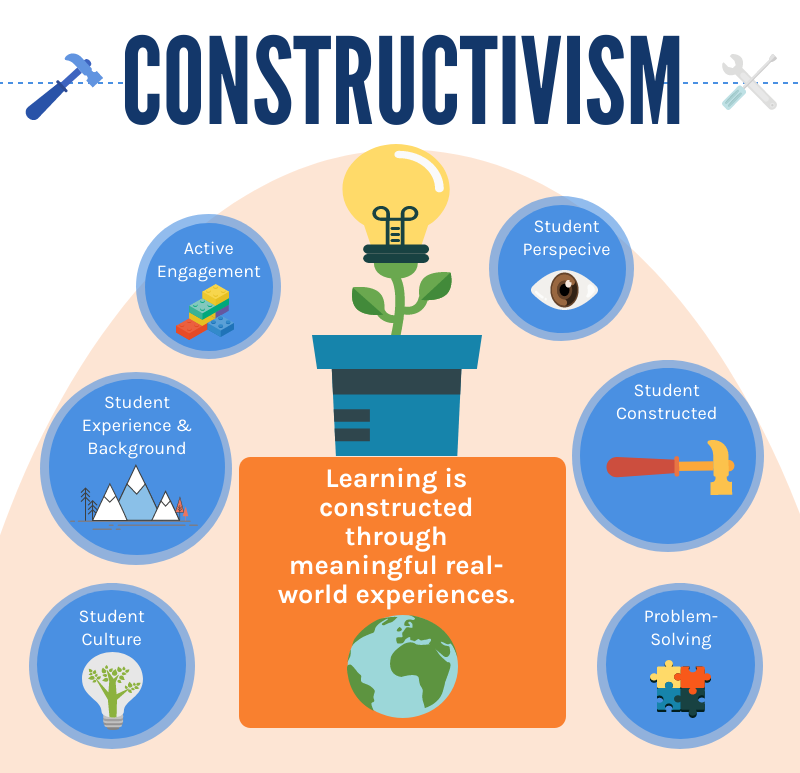
Constructivism can be cognitive, social, and radical.
Cognitive constructivism says that learning must be related to a learner’s stage of cognitive development. Knowledge is actively constructed by learners based on their existing cognitive structures. This is why a learner’s existing intellectual framework is critical to understanding the learning process.
Social constructivism says that the development of knowledge depends on how people interact with each other, their culture, and their society. As per this theory, knowledge is a result of the mind making sense of experiences and social interactions.
Radical constructivism says that knowledge is invented, not discovered. It says that it is not possible to know the truth or reality around us in its entirety. It’s only interpretations of knowledge that happen with a learner using mental constructs (inventing) trying to make sense of the knowledge/learning based on one’s own past experiences.
Constructivism learning activities are based on tutors using group work, collaboration, interactive activities, and using open dialogues (to find solutions).
MaxLearn picks on this while creating its algorithms to ensure that learning goals are based on a learner’s previous knowledge and skills. Group engagement and collaborative exercises in microlearning are encouraged by this theory. Plus, personalized learning paths get auto-adjusted depending on how a learner interacts and performs on the platform. This makes the platform adaptive, one that customises content dynamically to each learner’s progress. The result: a deeper understanding through contextual and relevant content. Moves away from a one-size-fits-all content overload.
Summary: Team Challenges, role-based Learning Goals and learning paths help learners build understanding through participation, application and collaboration.
D. Connectivism
talks about changes in the way we learn due to the exponential increase in information because of digital technologies and connectivity.
In the digital age, learners and educators have come to rely heavily on technology to learn, seek answers, and find information.
Connectivism suggests that a learner is required to combine thoughts, theories, and information in a way that it’s useful to us. Technology becomes a major element of the learning process. Constant connectedness through digital devices gives us tremendous opportunities to choose different and innovative ways of learning.
Even remotely when a single user or learner is not in the classroom, one can have group collaboration and discussions with digital devices. So, you are never out of touch with people when connected digitally! This digital connectedness allows a learner to share and absorb different viewpoints and perspectives related to making decisions, solving problems, and making sense of information.
Connectivism is all about learning that happens outside of an individual through social media, eLearning platforms, microlearning apps, blogs, LMS, or different information databases.
Summary: with multi-device access, collaborative learning experiences and continuous digital connect, learning extends beyond a formal classroom.

Principles of connectivism:
(a) Learning or knowledge is based upon ‘diversity of opinions’,
(b) Learning is a process of connecting,
(c) the ability to see connections between ideas & concepts is a core skill,
(d) Decision-making is a learning process considering a constantly changing information climate.
The benefits of connectivism are that it creates collaboration, empowers a learner as well as an educator/trainer, and embraces diversity!
Connectivism can be used in a classroom, or a virtual environment by way of social media, eLearning, LMS or microlearning platforms, gamification of teaching material with assignments and activities, and simulations to engage in deep learning!
How MaxLearn Reflects the Big Four Learning Theories
There isn’t any one source/theory to tell us how people learn. The aim is to pick, reflect and draw what’s meaningful from each concept’s insights to design effective workplace learning.
MaxLearn reflects many of these principles to offer a platform with capabilities like reinforcement, memory enhancement, active participation, collaboration and continuous learning.
| Learning Theory | Educational Principle | How MaxLearn Reflects It | Practical Benefit |
|---|---|---|---|
| Behaviourism | Reinforcement and observable behaviour | Challenges, spaced repetition, assessments, gamification, analytics | Encourages repeated practice and measurable progress |
| Cognitivism | Information processing, memory, retrieval | Learning Cards, AI Author (KLP extraction), adaptive learning, spaced repetition, retrieval practice | Helps learners process, organise and retain knowledge |
| Constructivism | Active knowledge construction | Team Challenges, scenarios, learning paths, role- and risk-based goals | Learners build understanding through engagement and application |
| Connectivism | Learning through digital connections | Mobile learning, multiple learning assets, collaboration, continuous access | Supports learning anywhere, anytime across connected environments |
Clearly, effective workplace learning can be built better with knowledge of different theories. That’s because each theory/concept gives you knowledge of different strengths. A sound microlearning approach and platform must reflect many of them simultaneously.
For workplace learning, trainers need to know about multiple theories.
- Behaviourism talks about reinforcement.
- Cognitivism is focused on processing and memory.
- Constructivism shows the path to actively build knowledge.
- Connectivism sees technology and connected learning as important.
MaxLearn reflects on all these principles in its platform with capabilities that help trainers design microlearning modules that are engaging, adaptive, measurable and relevant.
To conclude, these four learning theories viz. Behaviourism, Cognitivism, Constructivism and Connectivism provide a firm foundation and perspective on how people learn. MaxLearn reflects many of these principles to give you a platform that helps trainers create better microlearning lessons and outcomes.


