

What Ivan Illich Teaches Us About Designing Better Microlearning
Ivan Illich’s ideas help trainers understand how to design microlearning that’s more relevant, flexible, and learner-centric.
Ivan Illich challenged the established idea of ‘structured education automatically leading to meaningful learning’. Learners’ completion rates, assessment scores, and certifications don’t give you sustainable performance. Learners forget, and often struggle to recall and apply what’s learned.
This is often seen in compliance, onboarding and other micro-targeted training programs that are forgotten within hours or days. Completion rates are met, but doubts over real understanding and application remain. Training gets completed, but behavior on the job doesn’t change. That’s a serious gap.
At A Glance
-Ivan Illich challenged the idea of structured (institutionalised) education leading to meaningful learning
-He introduced concepts like deschooling, conviviality, and accessible. To him, forcing or standardising learning was counterproductive.
-His, idea of ‘learning webs’ is akin to modern, workplace learning environments that are connected
-Microlearning refelects these principles with its personalised, adaptive, and learner-driven design
So why does this keep happening?
To understand Illich’s relevance today, we need to examine what he argued against, and why it still matters in the workplace.
Let’s explore Ivan Illich’s concepts, viz., deschooling, conviviality, and lifelong learning, and how they apply to microlearning.
Who Was Ivan Illich and Why Does He Matter Today?
His question: ‘Does structured, curriculum-driven education truly lead to meaningful learning outcomes?’
This question still troubles many training programs today.
Illich did not like the curriculum-based methods of teaching in schools.
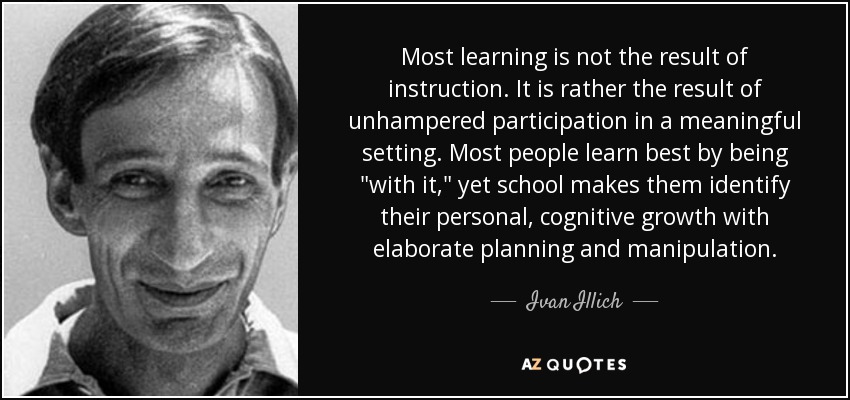
Illich spoke vehemently against the negative impact of schooling, and the negative effects of schools.

According to Illich, rigid curriculum-based learning ‘confuses’ and ‘restricts’ the mental growth of a learner.
Don’t modern workplace training programs continue to face this challenge unintentionally?
He argued that it stunted a learner’s ability to ‘process knowledge’ and make sense of the world around them.
Ivan Illich advocated a shift toward more convivial forms of learning. A convivial approach focuses on meaningful, joyful, cooperative, and self-directed learning experiences.
Conviviality, or Convivialism is the ability of individuals to interact creatively and freely with others and their environment to satisfy their own needs.
He advocated that ‘informal learning’ led to ‘lifelong learning’.
What Does This Mean for Workplace Learning?
Challenges faced by modern organisations:
-Employees are required to take mandatory training, but are unable to apply it
-Learning is pushed instead of meeting learner needs
-Standardised content is often not role- and risk-specific
-Engagement is low when lessons are not relevant
These remain persistent pain points across organisations, even today.
Illich tells us why this happens, and why the approach to learning needs to be different.
Why Did Illich Criticise Traditional Education?
Teaching doesn’t mean learning.
Passing a class or certification doesn’t mean competence.
Developing fluency/mastery over certain subjects does not make a learner innovative/creative.
Mindless ‘schooling’ stunts imagination and creativity of a learner.
Learning is often consumed, but not applied when it matters the most.
Learning content according to Illich must not become a commodity that is marketed.
What Is Conviviality?
Conviviality, or Convivialism to him nurtured a learner/student to interact creatively with their environment. This makes learning more meaningful, relevant and satisfying in the real-world contexts.
What Are Learning Webs and Why Do They Matter Today?
Illich proposed that an effective learning system must:
1. Allow access to learning resources on an anytime, anywhere basis
2. Enable people to share knowledge with willing learners
3. Create opportunities for people to contribute and exchange ideas (give and take)
This mirrors a modern workplace learning environment, where learning is- (i) accessible, (ii) collaborative, and (iii) contextually relevant.
Ivan Illich argued for a partially deschooled society. He felt that ‘more learning should be done at home, in offices and kitchens, in the contexts where knowledge is deployed to solve problems and to add value to people’s lives’.
Interpreting Illich Through Modern Microlearning
| Illich’s Idea | Educational Principle | How MaxLearn Reflects It | Practical Benefit |
|---|---|---|---|
| Deschooling | Move beyond one-size-fits-all learning | Personalized learning using adaptive algorithms based on learner performance and role-specific needs | Learning becomes relevant and tailored to individual needs |
| Conviviality | Enable active, learner-driven engagement | Gamified Team Challenges and interactive learning formats that encourage participation | Learners engage actively rather than passively consuming content |
| Learning Autonomy (akin to ‘informal learning’) | Allow learners to control pace and access | Mobile-first platform with multiple learning modes and self-directed learning paths | Learning fits into real work context and learner preferences |
| Continuous Learning | Learning happens over time, not in one event | Spaced repetition of key concepts and adaptive reinforcement | Improved retention and long-term recall |
| Relevance & Context | Learning must be meaningful to the learner | Risk-specific, goal-driven learning assignments tailored to job roles | Learners focus only on what matters to their role |
| Decentralised Knowledge Creation | Knowledge is created and accessed dynamically | AI-powered authoring tool that generates learning content, questions, and key learning points | Faster content creation and scalable learning design |
| Feedback & Reflection | Learning improves through feedback loops | Real-time analytics tracking learning progress, gaps, and outcomes | Trainers gain visibility and can refine learning continuously |
With microlearning, you don’t control how and when learning happens. Instead, you focus on enabling learners to access, apply, and build knowledge meaningfully.
This reflects Illich’s ideas of learning not being imposed, but being promoted through interaction, context, and relevance.
Illich’s ideas remind us that learning should not be controlled, but enabled. This shift from delivering training to enabling learning becomes so much easier with microlearning. It simply helps you build and sustain capability.
To conclude, microlearning allows us to move from standardised training to relevant, learner-driven experiences to enable real-world application. When learning becomes meaningful and contextual, you go beyond meeting training requirements to building capability.


