

Jerome Bruner’s discovery learning theory is the key to shaping the way microlearning is designed and delivered.
In discovery learning, the learner is not a passive recipient of information. Instead, they actively engage with content, forming new knowledge based on what they already know.
This approach is particularly effective in microlearning, where the focus is on delivering small, bite-sized lessons tailored to the learner’s needs.
MaxLearn’s platform has built on the wisdom of this theory in its robust microlearning platform with features and benefits that rely on the wisdom of learning theories and best practices, just like Bruner’s discovery learning theory.
In this article, we’ll explore how Bruner’s ‘Discovery Learning Theory,’ ‘Spiral Curriculum,’ ‘Schemas and Mental Models,’ and ‘Three Stages of Intellectual Development’ apply to microlearning.
Bruner’s Discovery Model and Microlearning
In microlearning, the principles of discovery learning are applied by offering content that prompts learners to explore, question, and build upon their existing knowledge. For instance, a microlearning module might present a scenario relevant to the learner’s job role, encouraging them to think critically and draw connections between the new information and their prior experiences. This mirrors Bruner’s idea that learning is an active process of discovery.
Streamlining Knowledge for Effective Learning
Imagine organizing a toolbox. You wouldn’t throw all your tools into a single drawer; you’d arrange them by size, purpose, and frequency of use. Similarly, in microlearning, knowledge must be structured to simplify complex ideas, making it easier for learners to grasp and apply new information.
Building Personalized Learning Pathways
Bruner’s discovery learning is like putting together a puzzle. Learners build their own understanding by connecting pieces of information. In microlearning, this means creating lessons that help employees in different job roles, departments, or with varying levels of experience, find the right “puzzle pieces” that fit their specific needs. Instead of a one-size-fits-all approach, lessons are micro-targeted based on an individual’s risk profile, learning style, and existing knowledge.
Trainers as Guides, Not Lecturers
Think of trainers as GPS systems. They don’t drive the car for you; they guide you to your destination based on your specific route. In microlearning, trainers facilitate the learning process, helping employees discover key connections between different bits of information. This approach ensures that lessons are relevant, engaging, and tailored to each learner’s unique path, making the learning process both efficient and meaningful.

Benefits of Bruner’s Theory for Microlearning
Bruner’s Discovery Theory is tailor-made for Microlearning. The following benefits are especially relevant to microlearning, which emphasizes creating engaging, personalized, and effective learning experiences for each individual.
Promotes Active Learner Engagement: Encourages learners to actively participate in their own learning process.
Sparks Curiosity: Stimulates curiosity, driving learners to explore and discover new concepts.
Cultivates Lifelong Learning Skills: Helps develop skills that encourage continuous learning.
Personalizes the Learning Experience: Tailors lessons to individual needs.
Boosts Motivation: Offers learners the opportunity to experiment and learn through trial and error.
Builds on Prior Knowledge: Leverages what learners already know to enhance understanding.
Moreover, microlearning platforms like MaxLearn use adaptive learning technology to tailor each lesson to the individual learner’s level of understanding. This ensures that learners are not overwhelmed with information that is too complex or bored by content that is too simple. Instead, they are guided through a learning path that gradually increases in difficulty as they master each concept, much like Bruner’s concept of a spiral curriculum, where learners revisit and build upon basic ideas over time.
Bruner’s Spiral Curriculum
Bruner proposed the concept of spiral curriculum to aid this process of self-discovery. Spiral curriculum is all about revisiting basic ideas over and over again, building upon them, and explaining them till they are completely understood (mastered)!

Bruner’s spiral curriculum closely parallels the simplified version of Bloom’s Taxonomy, which breaks down learning into four levels: Awareness → Explanatory → Practitioner → Mastery.
Bruner adds a new dimension by showing how mastery is achieved through “revision,” using methods like “spaced repetition” and “retrieval practice” (questions/quizzes/assessments) in effective microlearning platforms. Learners reach mastery by gradually increasing the difficulty level of learning content and encountering the same information in different contexts.
Building Blocks: Schemas and Mental Models
Organizing Knowledge for Effective Learning
At the heart of Bruner’s theory are schemas and mental models—cognitive structures that help learners organize and interpret information.
In the context of microlearning, these building blocks are crucial for helping learners make sense of new content.
Schemas and mental models are like the ‘mental frameworks’ that learners use to categorize and link concepts, much like organizing files in a computer. Without these structures, learning can feel disjointed and confusing.

Microlearning leverages these cognitive structures by presenting information in a way that is easy for learners to digest and integrate into their existing knowledge base.
For example, a microlearning snippet might use a video or infographic or even a short podcast to help learners see how a ‘new concept’ fits into what they already know.
This visual representation of information aligns with Bruner’s emphasis on using multiple modes of representation (such as images, symbols, and words) to enhance learning.
This includes activities like quizzes/questions (retrieval practice), simulations, or scenario-based learning, which require learners to apply their mental models to solve problems or make decisions. By doing so, learners are not just passively consuming information but actively constructing their own understanding—just as Bruner advocated.
Stages of Intellectual Development: Tailoring Lessons to the Learner’s Level
Customized Learning Journeys for Maximum Impact
Bruner identified three stages of intellectual development that learners typically go through: the enactive stage (learning through action), the iconic stage (learning through images), and the symbolic stage (learning through abstract concepts). These stages provide a roadmap for designing microlearning modules that are perfectly tailored to the learner’s current level of understanding.
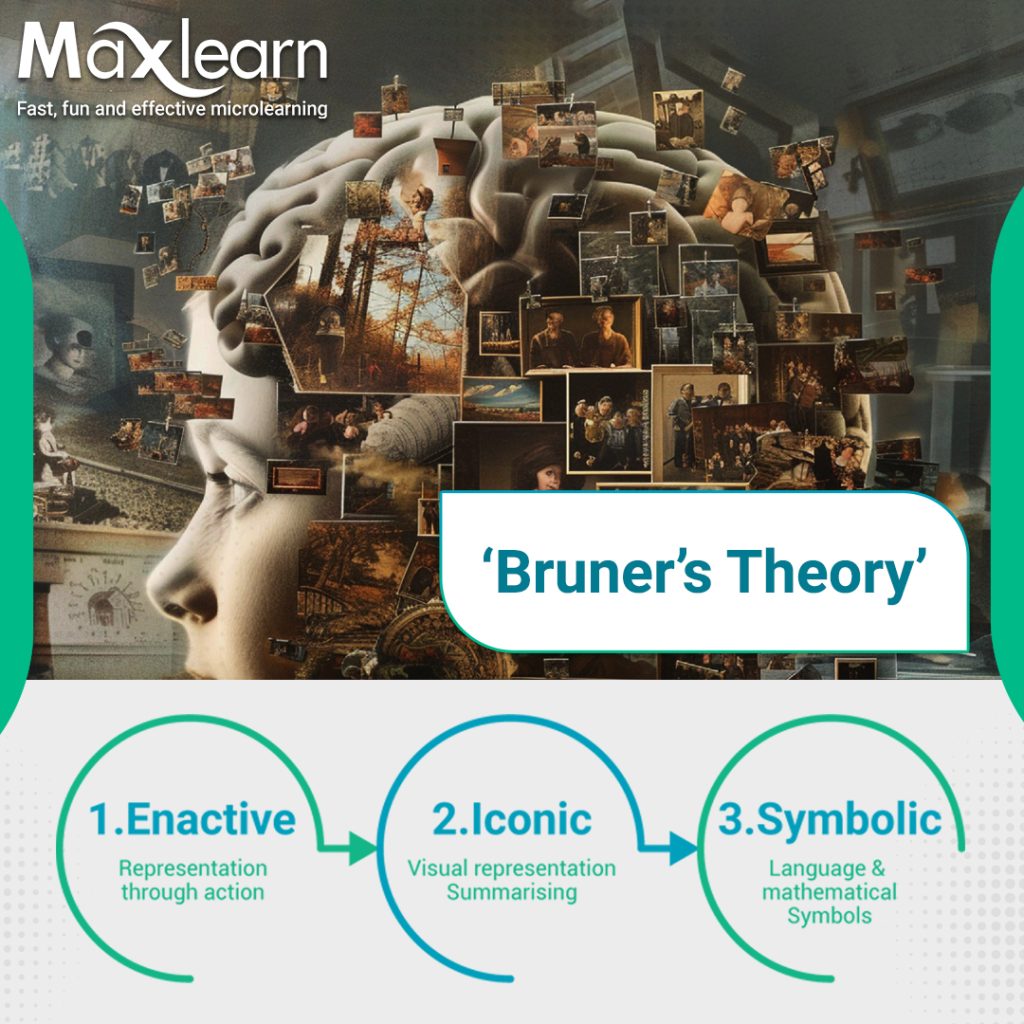
In the enactive stage, learners are hands-on, engaging with the content by performing actions or tasks. Microlearning can cater to this stage by offering interactive simulations or role-playing exercises that allow learners to practice new skills in a safe environment. For example, a microlearning module for customer service training might include a simulation where the learner practices handling a difficult customer interaction, receiving immediate feedback on their performance.
As learners progress to the iconic stage, they begin to rely more on visual representations to understand concepts. Microlearning can support this stage by incorporating rich visual content, such as infographics, videos, or diagrams, that illustrate complex ideas in a clear and accessible way. This is particularly effective in fields like technical training, where learners may need to visualize the inner workings of machinery or software.
Finally, in the symbolic stage, learners are able to think abstractly and apply their knowledge to solve complex problems. Microlearning can challenge learners at this stage by presenting them with case studies, advanced quizzes, or problem-solving exercises that require them to draw on their full range of knowledge and skills. By progressively increasing the difficulty level of the content, microlearning ensures that learners are continually challenged and engaged, preventing stagnation and promoting ongoing intellectual growth.
Connecting Bruner’s Theory with MaxLearn’s Fast, Fun, and Effective Approach
MaxLearn’s microlearning platform is deeply rooted in the principles of Bruner’s discovery learning theory, particularly in its commitment to creating personalized, engaging, and effective learning experiences. By incorporating spaced repetition, adaptive learning, and gamification, MaxLearn ensures that learning is not just a one-time event but an ongoing process of discovery.
Fast Learning: MaxLearn’s rapid content development and delivery allow learners to quickly engage with new material, reflecting Bruner’s idea that learning should build on existing knowledge and be readily accessible. The platform’s AI-powered authoring tool enable creators to develop tailored content that meets the unique needs of each learner, ensuring that they are always learning up-to-date content and at the appropriate level of difficulty.
Fun Learning: By integrating gamification, MaxLearn taps into the motivational aspects of Bruner’s theory, making learning an enjoyable and rewarding experience. The platform’s use of points, badges, and collaborative challenges not only makes learning fun but also fosters a sense of community and teamwork among learners, aligning with Bruner’s belief in the social nature of learning.
Effective Learning: MaxLearn’s use of spaced repetition and adaptive learning ensures that learners retain and apply what they’ve learned over time, combating the forgetting curve and promoting long-term knowledge retention. By tailoring the learning experience to the individual learner’s needs and abilities, by risk profiling the job roles and micro-targeting learners with Risk-specific assignment of content and learning goals, MaxLearn creates an environment where learning is not only effective but also meaningful and relevant.
Bruner’s discovery learning theory provides a powerful framework for designing effective microlearning experiences. By focusing on the active construction of knowledge, the use of schemas and mental models, and the stages of intellectual development, microlearning platforms like MaxLearn can create personalized, engaging, and impactful learning journeys.
To conclude, MaxLearn’s commitment to being fast, fun, and effective ensures that the principles of Bruner’s Theory of Discovery Learning are aptly utilized, and learners not only acquire new knowledge but also retain and apply it in meaningful ways, leading to sustained learning and success in their roles.


