
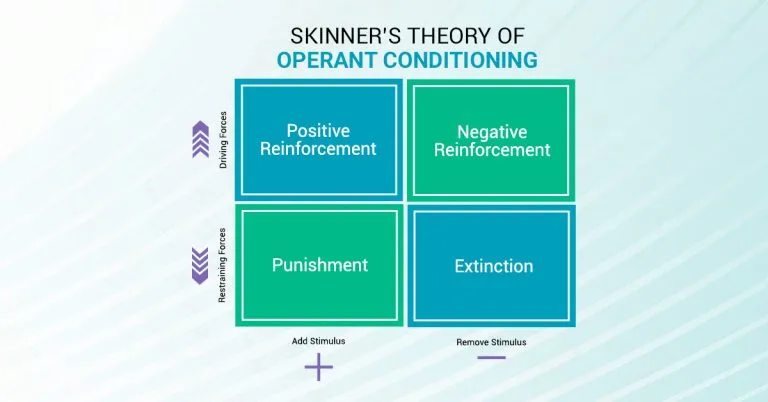
How Does Skinner's Theory Strengthen Microlearning Design?
What is the relevance of awarding badges? Why do people love seeing their names on leaderboards? What motivates a learner to keep returning to an LMS to complete one’s allocated training modules? Skinner gave us the influential ‘Operant Conditioning’ learning theory to answer all these questions… It helps you comprehend a learning framework better while implementing learning approaches like microlearning.
At a Glance
- Skinner’s Operant Conditioning tells us how behaviour is shaped by reinfocement and punishment.
- Many Microlearning techniques are based on Skinner’s work, especially, gamification, leaderboards, badges, quizzes.
- Skinner’s ‘shceduled reinforcement’ is akin to ‘spaced repetition’ in microlearning.
- Reinforcement strengthens desired workplace behaviours. This reduces risk-prone of employees at work.
- MaxLearn operationalises these concepts by way of adaptive learning, gamification, spaced reinforcement, retrieval practise (questions/quizzes) and targeted learning paths.
- Stronger retention, better complaince, and improved workplace performance.
Skinner’s learning theory serves as the foundation for many elements of microlearning such as gamification, assessments/quizzes, rewards, feedback, and learner motivation.
Applying Skinner's Theory in Microlearning Design
Here’s an example: In a gamified learning module, a learner aims to ‘play to win,’ tapping into the universal love for games and experiencing a range of emotions with rewards and penalties. Specifically, in microlearning gamification, a learner/player:
- Experiences joy with a winning strike
- Feels relief overcoming an obstacle
- Faces fear of making a wrong choice
- Encounters frustration upon losing a game/point
Skinner’s theory equips you to handle rewards and punishments (deterrents) when designing your microlearning assets.
In a workplace, you don’t want procedures, processes, and policies taken lightly. Therefore, your microlearning initiatives must incorporate a system that both motivates, and acts as a deterrent in preventing lapses/gaps. especially in sensitive tasks/activities related to operational risks, regulatory & compliance matters, health and safety precautions/procedures among others.
Skinner’s theory of ‘Operant conditioning’ provides the tools to seamlessly weave your microlearning content together. Plus, the element of ‘reward & punishment’ actually enhance learning, and solidify the ‘memory retention’ of your workforce, and avoiding many business risks!
With this background, let’s dive deeper…
The Background- Skinner’s Experiments
How did Skinner arrive at his theory? He emphasized on the role of ‘conditioning’ during the learning process.
He used an operant conditioning chamber, or ‘Skinner box’, and placed an animal (rat) in it.
- A reward mechanism to dispense food pellets was placed in it.
- Punishments were imposed by giving electric shocks.
It was observed that the animal became more adept at handling stimuli based on whether it encountered a ‘reward’ or a ‘punishment’.

The same goes for humans- your workforce also desires to earn a reward and steer clear of punishment.
Skinner’s Theory of ‘Operant Conditioning’ Further Explained
Operant conditioning is a learning process where a ‘certain behavior’ is modified using reinforcement (approval) or punishment. This procedure strengthens learning of the right or acceptable behaviors!
This theory helps you understand ‘how a behavior is learnt’ and how ‘reinforcements’ helped enhance the learning process.
Skinner proposed that ‘scheduled’ (periodic) reinforcements had a direct impact on ‘conditioning the learner’s brain’. He called it ‘behavioral shaping’ , where an ‘expected response’ can be reinforced. This helps learners learn towards demonstrating a certain ‘desired behavior’.

With reinforcements, the expected or right behaviors increase, and with punishment, the undesirable behaviors decrease, just like the rat in Skinners experiment.
Operant conditioning and reinforcements happens in humans right from childhood.
During a child’s developmental years, parents nurture them by administering rewards, which signify ‘approval for socially acceptable behavior’. This parental approval can manifest as a ‘praise’ for actions like giggling, drinking milk, crawling, or making efforts to walk. These forms of praise serve as positive reinforcements that endorse specific behaviors.
Similarly, punishment awaits a child when a behavior is deemed ‘socially inappropriate’. The child receives verbal warnings and discouragement to deter the repetition of unacceptable actions.
Why Operant Conditioning Still Matters in Workplace Learning?
Today’s disruptive times require organisations to deal with challenges like compliance failures, safety lapses, cybersecurity mistakes, and operational risks/errors. Training has to do more than transfer knowledge. It must influence behaviour in order to avoid consequences.
This is where Skinner’s theory becomes valuable. Reinforcement and corrective mechanisms are a must to create and sustain desirable workplace behaviours. A learning culture is needed where people don’t forget their core skills, and capability is built continuously to reduce costly mistakes. Everyone must be constantly and continually supported with relevant and bite-sized training inputs regardless of one’s role- and risk-specific learning needs.
Positive & Negative Reinforcement/Punishment in Training Context
Here let’s discuss- 1) positive reinforcement, 2) negative reinforcement, 3) positive punishment, and 4) negative punishment
In the world of learning, positive reinforcement is like a high-five for doing something right.
At workplace, a good action gets reward with gestures like praise or, gold-star pins, certificates, good ratings in performance appraisals etc. This makes you want to keep being awesome at work in the future too! Trainers often use cheers and recognition tokens to make this happen.
Negative reinforcement is when you encourage good behavior by avoiding something bad (a negative outcome or stimuli). It’s like taking an antacid before a spicy meal to prevent discomfort. At work, nobody wants to score below a set benchmark in tests given by the trainer. It’s a way of saying, “Do well, or things might not go smoothly.” That’s negative reinforcement!
Now, let’s talk about positive punishments – it’s like a wake-up call for the kids imposed by parents. If you step out of line, you might get grounded or stuck in detention. Positive punishment puts rules in place when someone acts in a not-so-great way.
Trainers also use positive punishments, like having to redo a test section or getting a red card in microlearning. No learner one wants to be labeled as a slacker. So, people work hard to avoid being called out, and remain motivated to stay above the minimum expectations at work, or in achieving training benchmarks/tests.
Then there’s negative punishment – it’s like taking away a privilege when someone goofs-up. Fail a simple test, and you don’t get certified, or lose your existing certification. While your certified buddies celebrate, you might face some consequences. It’s a way to make sure everyone keeps their game strong.

Skinner’s Theory Applied in Microlearning
A good grasp of this theory helps you in creating microlearning assets like games, in designing assessments etc. For instance, while designing the learning-levels at a topic-level, you get to design rewards like conferring of badges, earning points etc. based on the learning progress of a learner. Even quiz questions are designed such that you award points for the right responses, and deduct points for wrong responses.
Skinner’s theory also forms the basis of microlearning algorithms that offer content to a learner based on one’s learning-level. A slow-learner is given more content exposure with ‘spaced repetition’, and is not rewarded with points/badges unless the required proficiencies are met.
Those with higher mastery of their skills receive greater recognition through points, badges, or leaderboards. This encourages each one to retain their sense of pride resulting in continued engagement and capability improvement.
This helps organisations identify capability gaps and potential business risks. It also helps support and motivate learners who progress at a slower pace.
The microlearning platform’s algorithms match content difficulty to each learner’s level. Skinner’s proposal of ‘scheduled reinforcements’ is akin to spaced repetition in microlearning.
His theory of ‘behavioral shaping’, where an ‘expected response’ results in a desired behavior helps you serve the 4 purposes of microlearning- viz. to supplement, reinforce, augment and remediate your training initiatives.
| Purpose | Skinner Application |
|---|---|
| Supplement | Reinforce new knowledge using positive feedback |
| Reinforce | Scheduled repetition. It strengthens desired behaviours |
| Augment | Reward progression and encourage advanced levels of learning |
| Remediate | Errors are corrected using guided reinforcement |
The concepts of positive & negative reinforcement and punishment help you think right while designing a microlearning lesson, while creating content, or in setting learning benchmarks. They help you appreciate the ‘individual differences’ of learners, and their ‘cognitive processes’ with better clarity and conviction.
By using ‘reinforcements periodically’ as ‘spaced reinforcement’ in microlearning, you get to reiterate important topics just before they are about to be forgotten. Of course, you will need a robust microlearning platform to give you the technological, automation and AI edge!
Skinner Meets Modern Learning Science
While Skinner kept his focus on ‘behaviour change’, modern microlearning platforms get the best out of his principles through AI-powered authoring, adaptive learning, retrieval practice, and spaced reinforcement.
In a nutshell, Skinner’s focus on behavioural reinforcement and microlearning complement each other with these concepts:
- Spaced Repetition
- Retrieval Practice
- Adaptive Learning
- Goal-Driven Learning
- Gamification
- Scenario-Based Learning
These approaches create synergies by strengthening retention, improving performance, and supporting lasting behaviour change.
MaxLearn’s microlearning LMS applies Skinner’s principles through targeted content delivery, AI-driven authoring, and goal-based learning pathways.
Skinner’s theory applies to virtually every workplace learning scenario. Its principles are aimed at motivating learners, reinforcing critical knowledge, shaping behaviors, and reducing business risk.
Modern AI-powered microlearning platforms such as MaxLearn deliver outcomes that go far beyond training. Such platforms enable stronger retention, better decision-making capability, improved compliance adherence, and a workforce with sustainable performance capabilities meant for real-world conditions.
Explore how MaxLearn can drive behavioral change in your workforce.
And discover the future of employee learning today.
Schedule a Call


